
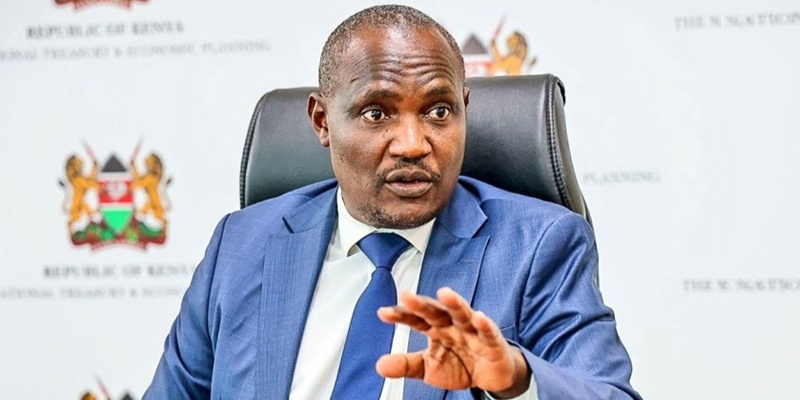
06 Sep Interview with John Mbadi, Cabinet Secretary for the National Treasury and Economic Planning of Kenya
The government has made fiscal consolidation and debt sustainability central to its economic policy. What is your assessment of Kenya’s economic outlook, and what are the National Treasury’s priorities for maintaining growth, price stability and confidence in the Kenyan shilling?
MBADI: Kenya’s economy remains resilient despite a challenging global environment marked by geopolitical tensions and supply disruptions. We have the ongoing war in Ukraine, the conflict in the Middle East and global trade tensions. Despite these challenges, Kenya’s economy continues to grow above both the global and regional averages. Real GDP growth accelerated to 5.3% in the first quarter of 2026, compared with 4.9% in the same period in 2025. We project growth of about 5% in 2026, up from 4.6% last year, and expect it to reach around 5.1% in 2027. This performance is supported by the underlying strength and diversity of our economy. We are not overly reliant on any one sector. Agriculture remains significant, but other sectors are also making strong contributions. Growth has been driven by stronger agricultural productivity and a recovery in private-sector credit. Credit growth, which was negative in early 2025, has now recovered to almost double-digit growth. This is having a very positive impact on the economy. There is also continued expansion in services, particularly tourism. Tourist numbers have recovered strongly from the COVID era, when Kenya received fewer than 800,000 visitors. That figure has more than tripled to over 2.5 million.
The ICT sector is also performing very well, supported by Kenya’s strong human capital and culture of innovation. Financial services and real estate are also growing, with Kenya serving as a regional financial hub. Inflation remains a global concern but is still within the Central Bank’s target range of 5% plus or minus 2.5 percentage points. It rose from 4.1% in 2025 to 6.7% recently, largely due to higher oil prices and geopolitical disruptions. However, it remains below the upper limit of 7.5%. The Kenyan shilling has been one of the world’s most stable currencies, trading at around 129.2–129.5 to the U.S. dollar from 2025 to 2026. This stability is supported by healthy foreign-exchange reserves, which stood at more than $15 billion in August 2026, equivalent to 6.3 months of import cover—well above the three-month minimum. Our priority is to preserve macroeconomic stability while promoting inclusive growth and job creation. We are now moving from short-term stabilization to medium-term productivity. Since 2022, our focus has been on stabilizing an economy that faced significant refinancing risks and was among the African countries considered at risk of default.
We have now stabilized the economy and removed those refinancing risks. Our focus is on directing public resources toward sectors that expand productive capacity, drive growth and create jobs. Employment remains our single biggest challenge as a country. We have implemented fiscal consolidation and debt-sustainability strategies, with restoring fiscal discipline at the center of our medium-term economic strategy. Over the past two years, we have introduced financial, procurement and revenue-collection reforms to strengthen fiscal management. Public debt currently stands at 68.5% of GDP, down from 72% in 2022. While this is progress, it remains above our 55% target. We are therefore focused on reducing the fiscal deficit, improving revenue performance and maintaining tight expenditure controls. We are also shifting our debt portfolio away from expensive commercial borrowing toward longer-term, lower-cost concessional financing. We expect the fiscal deficit to narrow from 6.8% of GDP in 2025–26 to 4.9% by 2030–31, putting public debt on a more sustainable path.
Japan has historically been an important development partner for Kenya. How can we deepen that relationship beyond development cooperation into trade, investment and private-sector partnerships? How can Japan support these public-private partnerships?
MBADI: We have adopted several strategies to maintain the momentum of our development while addressing debt pressures. We need to find more innovative ways to finance infrastructure projects rather than relying solely on traditional borrowing. We also need to bring the private sector into public investment and create an environment where it can expand businesses and generate employment. That requires partnership on two fronts: finding creative, sustainable ways to finance major infrastructure projects and mobilizing greater private-sector investment. We are therefore thinking beyond conventional loans and debt and exploring new financing models through the two vehicles we currently have. The first is public-private partnerships, which have been operating for several years through a fully functioning PPP Directorate. A number of infrastructure projects have been initiated, particularly in transport, roads and energy.
One successful example is the Nairobi Expressway, running from Jomo Kenyatta International Airport through the city and westward. It has helped transform transport and decongest Nairobi. Another major PPP project is the Rironi–Mau Summit Road, which will improve transport along the western corridor. There are also several PPP projects underway in the energy sector. Beyond PPPs, we have also established the National Infrastructure Fund. The law was passed toward the end of last year, and we have now put its governance structure in place, including a competitively recruited board. The Council provides policy oversight, while the board is responsible for managing and implementing the fund. The fund is designed to crowd in private-sector investment by partnering with investors and mobilizing capital for infrastructure. We have also recently approved its investment policy. We have raised close to $3 billion through the divestiture of part of the government’s stake in Safaricom, our largest and most profitable company in the region, and we have also privatized Kenya Pipeline Company. These resources will help us mobilize additional private capital for infrastructure development. Japan and JICA can support us in several ways. First, you can participate through innovative financing mechanisms such as the National Infrastructure Fund and public-private partnerships. Japan has been a longstanding development partner, providing concessional and semi-concessional financing that lowers the cost of external borrowing. We are very grateful for that support, as well as your assistance with capacity building and technology transfer. The other major area is supporting the private sector, particularly micro, small and medium-sized enterprises. More than 80% of Kenya’s economy is informal, and our goal is to help businesses transition into the formal sector and grow. Japan and JICA can help us mobilize private capital for public infrastructure, partner on major infrastructure projects, and provide financing and technical support to MSMEs. These are areas where I believe we can build a strong partnership.
The double-taxation agreement with Japan is still under negotiation. How are those discussions progressing?
MBADI: We have double-taxation agreements with many countries, yet, interestingly, we have not concluded one with Japan, despite our longstanding development partnership. A double-taxation treaty should be relatively straightforward to negotiate, particularly given the strength and history of our relationship. I do not think it should be a major challenge.
What do you see as the future of Kenya-Japan economic relations over the next five to 10 years?
MBADI: Looking ahead, our vision is to make Kenya East Africa’s premier green, knowledge-based and globally competitive industrial hub by 2045. We have already begun a serious transformation across nearly every sector of the economy. Achieving this vision will require sustained international partnerships, and Japan remains one of Kenya’s most important strategic partners. Japan’s contribution goes beyond financing. It brings technological expertise, environmental sustainability, strong governance standards and practical experience, particularly in areas such as energy. Our partnership with Japan can help Kenya strengthen its position as a regional anchor, a technology hub and a gateway for investment into Africa. We see the Kenya-Japan relationship as a transformative economic partnership capable of supporting long-term regional prosperity and shared global growth.
Would you like to add anything else?
MBADI: Our capital market has become increasingly strategic, helping mobilize domestic savings, institutional capital and private investment alongside concessional financing. In 2026, it has recovered strongly, with market capitalization exceeding 4 trillion Kenyan shillings. Kenya’s capital market is now among Africa’s strongest, at times ranking ahead of South Africa and Egypt, and has ranked as high as fourth globally. This reflects not only a deeper market but also renewed investor confidence. We have improved the business environment, simplified regulations and made it easier for investors to repatriate capital and dividends. These reforms have made Kenya more attractive to investment, and that confidence is reflected in the performance of our capital market. Kenya is an attractive place to do business, supported by our political stability and vibrant democracy. Our people have the right to protest, and while demonstrations can sometimes turn violent, the country quickly returns to normal. We have a young, well-educated population, although job creation has not kept pace with employment needs. Despite occasional unrest, Kenya remains stable, and people return to work the following day. That resilience and stability make our economy attractive to investors.
What is your final message?
MBADI: Kenya is a stable, resilient and diversified economy, underpinned by political stability, a strong democracy and a highly skilled workforce. We hold regular elections, and while disputes arise, they are resolved within a robust constitutional and legal framework. We also have a strong, resilient economy and have consistently honored our sovereign debt obligations. Kenya has no risk of defaulting on its sovereign debt.